


By Jean Luc Cabirol
Some important dates to remember:
PREHISTORIC BEGINNING: 7000 to 3000 BC
In China (7000 BC) traces of fermented beverages made from rice, honey, and fruits including wild
grapes were found in Jiahu (Henan Province).
In Georgia (Caucasus) records of the oldest winemaking site were found (6000 BC). Pottery shards from
the Neolithic era were discovered with tartaric acid residues, indicative of grape wine.
Qvevris, large earthenware vessels, were used to ferment and store wine, a tradition still alive in
Georgian winemaking today.
At that time wine was discovered accidentally as a by-product of grapes storage. Grapes kept in jars
would leak juice due to gravity and weight, which would transform into a low-degree wine thanks to the
presence of natural yeasts in the grapes' skins allowing a spontaneous fermentation.
In Iran (Zagros Mountains-5000 BC) evidences of wine storage in jars were found at the site of Hajji Firuz Tepe.
FROM 3000 BC TO 500 BC IN THE ANCIENT WORLD
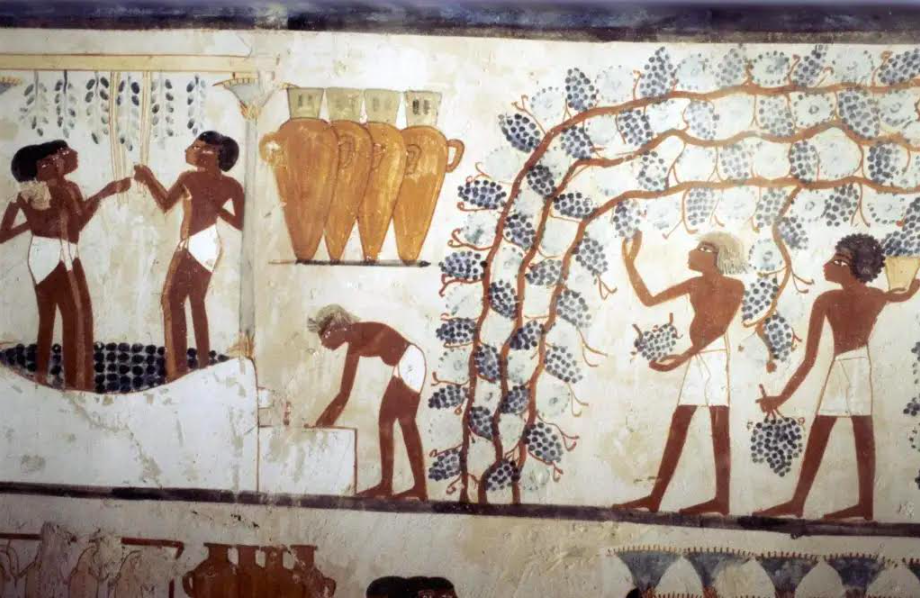
Wine was a luxury in Egypt and Mesopotamia. Only the elite had access to that beverage also used for
religious ceremonies. The Sumerians wrote about wines.
Pharaohs in Egypt enjoyed wine. Wall paintings in tombs showed vineyards and winemaking. Red wine
was offered to the Gods as a symbol of blood.
Canaanites and Israelites developed vineyards and wine culture. The wine was used to symbolize joy and
blessing in the Bible.
Phoenicians played a crucial role in spreading viticulture across the Mediterranean. They transported
grapevines and wine to Carthage, Sicily, Sardinia, and Spain.
FROM 500 BC TO 500 AD
Wine was central to Greek culture and mythology. Dionysus, the God of wine, embodied ecstasy and
chaos. Greeks refined winemaking techniques by adding resins, spices and aging them in amphorae.
Diluted wine was used in social drinking parties where philosophical and political discussions occurred.
Romans improved dramatically viticulture, using systematic techniques and developing tools for pruning
and grafting. They introduced amphorae for keeping and transporting wine. They created vast vineyards
in Gaul, Hispania, and Germania. Wine was democratized. Everyone from slaves to emperors could have
access to it. The Catholic Church later inherited Roman wine culture.
MIDDLE AGE: 500-1500 AD
The Fall of Rome ignited the rise of the monastic culture. Viticulture declined with the collapse of the
Empire and vineyards were mainly preserved where Christian Church was present. Monasteries
maintained vineyards for sacramental wine, developed detailed viticulture techniques, and established
famous vineyards in Burgundy, Champagne, and Rhine. In Muslim regions, wine survived for non-
Muslims and medicinal reasons.
1500-1800 AD: EXPLORATION AND COLONIALISM
European explorers carried vines to the New World: Spanish missionaries planted vines in Mexico,
California, Chile, and Argentina. Portuguese introduced viticulture to Brazil. Later, French and English
colonialists brought wine to South Africa, Australia, and New Zealand.
1800-1900 AD
Period of innovation, disease, and industry. Phylloxera (a tiny insect) devastated European vineyards late
1800s. The solution was to graft European vines onto resistant American rootstocks. The crisis reshaped
global viticulture and fostered new methods of cultivation.Systems of classification were implemented in France (Bordeaux 1855 classification …), Germany and Italy.
20TH CENTURY: FROM PROHIBITION TO FAME
US Prohibition (1920-1933) nearly eradicated production in that country. It took decades for the wine
industry to recover. Many vineyards were destroyed or abandoned during the 2 world wars. Starting in
1945 a great effort to rebuild vineyards in a more modern way was implemented. California developed
production and quality. Australia, New Zealand, and South Africa became major producers and
exporters of wines.
WINE TODAY
Vineyards are present on nearly all continents. Global trade, digital marketing, and tourism have
revolutionized the wine industry. Wine-making techniques have also undergone tremendous changes,
including a comeback to ancient techniques like amphorae wine-making and aging. Organic, biodynamic,
and natural wine practices have grown. Climate change has forced producers to adapt. Wine education
is considered as part of global education. Consumers increasingly favor quality over quantity. Wine has
become a symbol of lifestyle, terroir, and identity.
In conclusion, through over 8000 years of history, wine remains today more than a simple beverage, but
a symbol of human development, trade, religion, science, and celebration.